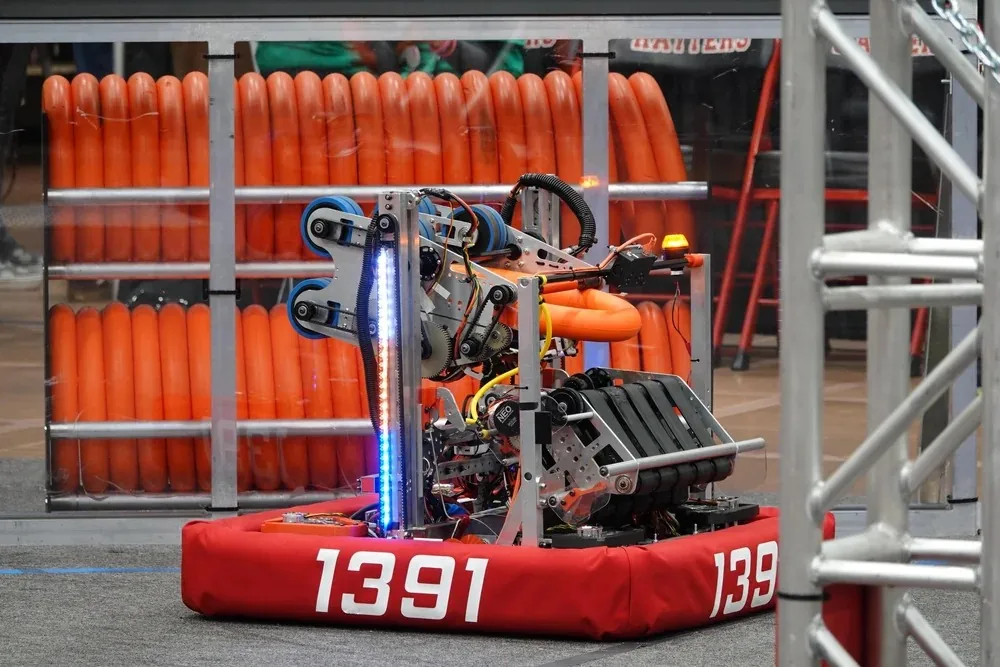
I spent three seasons on FRC Team 1391, The Metal Moose. In 2022 I was a builder on the Rapid React robot. In 2023 and 2024 I was Team Captain, Lead Builder and Robot Operator, responsible for the robot design and build, the engineering notebook, and a team of 30+ students across four sub-teams. We went to the World Championship in 2022 and 2024, and the 2024 robot ranked in the top 3% globally.
Overview
FRC teams get six weeks each season to design, build and program a robot for that year's game. Over three years I went from contributor to captain, from learning the tools to teaching them, and from building other people's designs to writing the documentation the team now uses.
As captain I was responsible for the team as well as the robot:
- Management: 30+ members across mechanical, electrical, programming and business sub-teams.
- Planning: build schedules, prototyping timelines and competition deadlines.
- Mentorship: trained new members in CAD, machining and design.
- Strategy: coordinated with alliance partners and adapted to field conditions.
- Documentation: set the team's engineering notebook practice.
Season by season
In 2024 (CRESCENDO) I was Team Captain, Lead Builder and Robot Operator. The robot was built around a four-bar intake I designed, with beam-break sensors and automated controls, and a dual-flywheel shooter with Limelight targeting. We won several awards including Engineering Excellence, competed at the World Championship and ranked in the top 3% globally.
Responsibilities
- Team Captain: managed the robot design and build process, coordinated between sub-teams, and led daily build meetings and progress reviews.
- Lead Builder: designed and built the four-bar intake with sensor-based detection and automated controls.
- Robot Operator: operated the robot at competitions.
- Documentation: wrote the engineering notebook covering the full development process, which became the team's documentation standard.
- Mentorship: trained new members in CAD, machining and design.
Mechanical systems
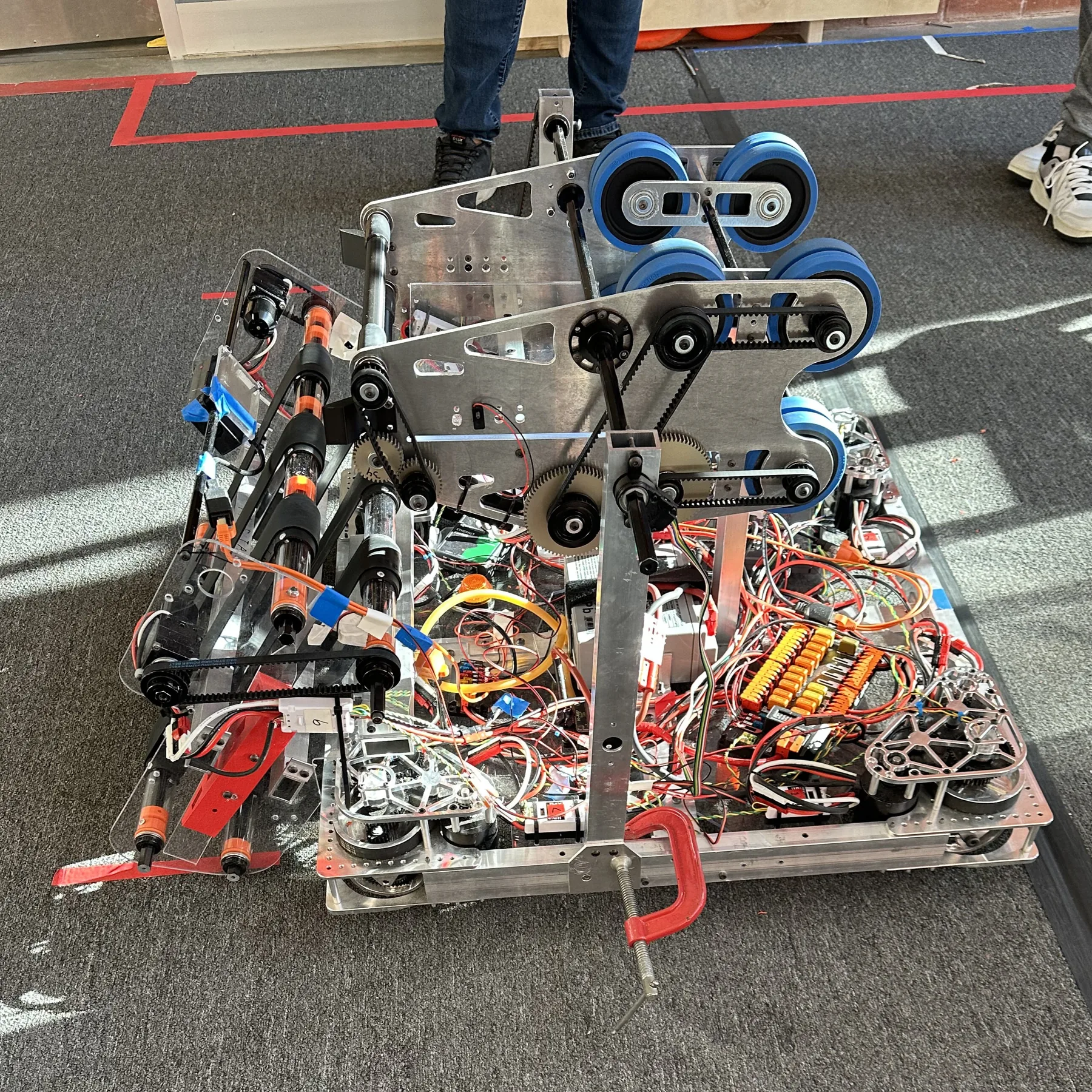
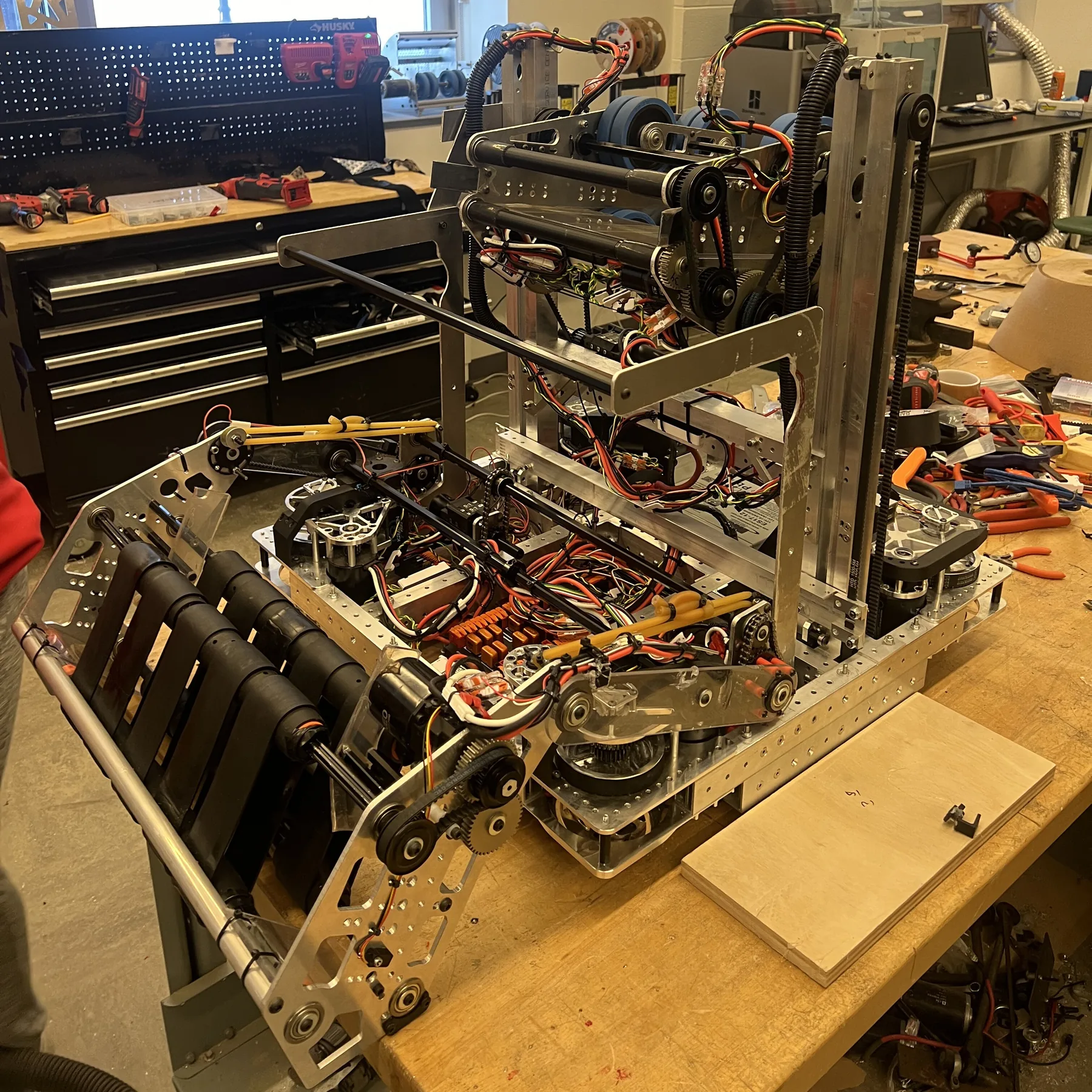
Four-bar intake
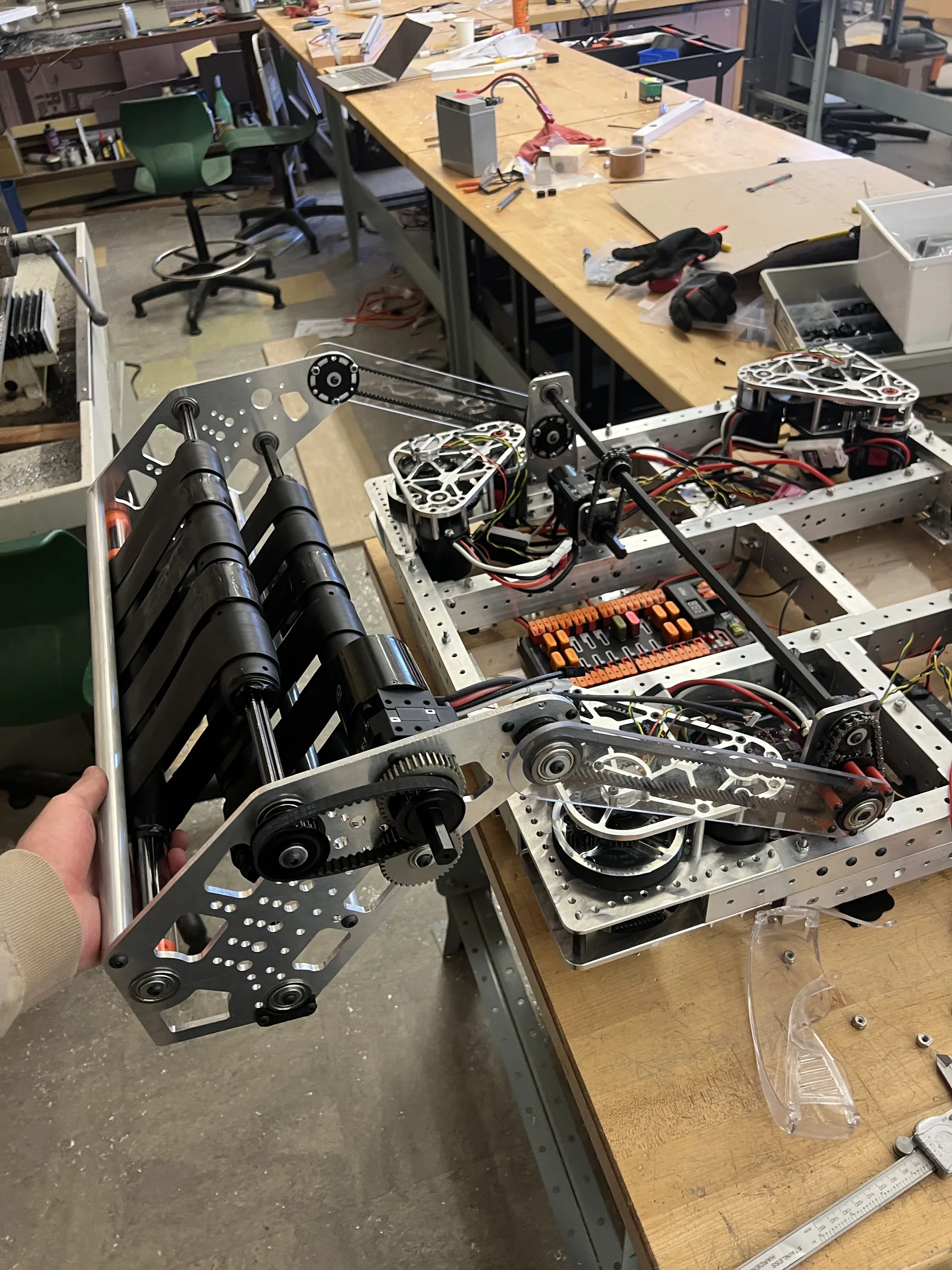
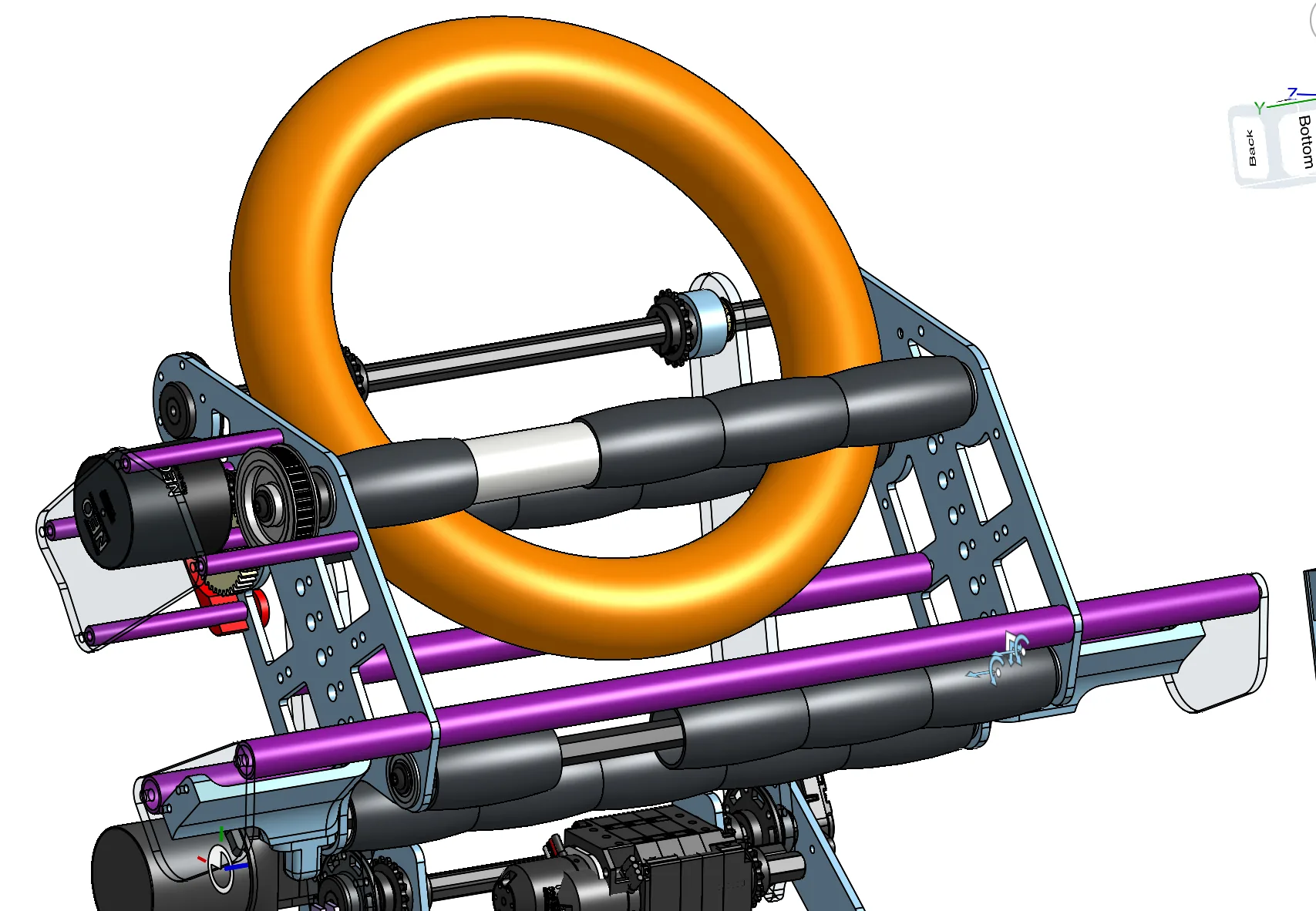
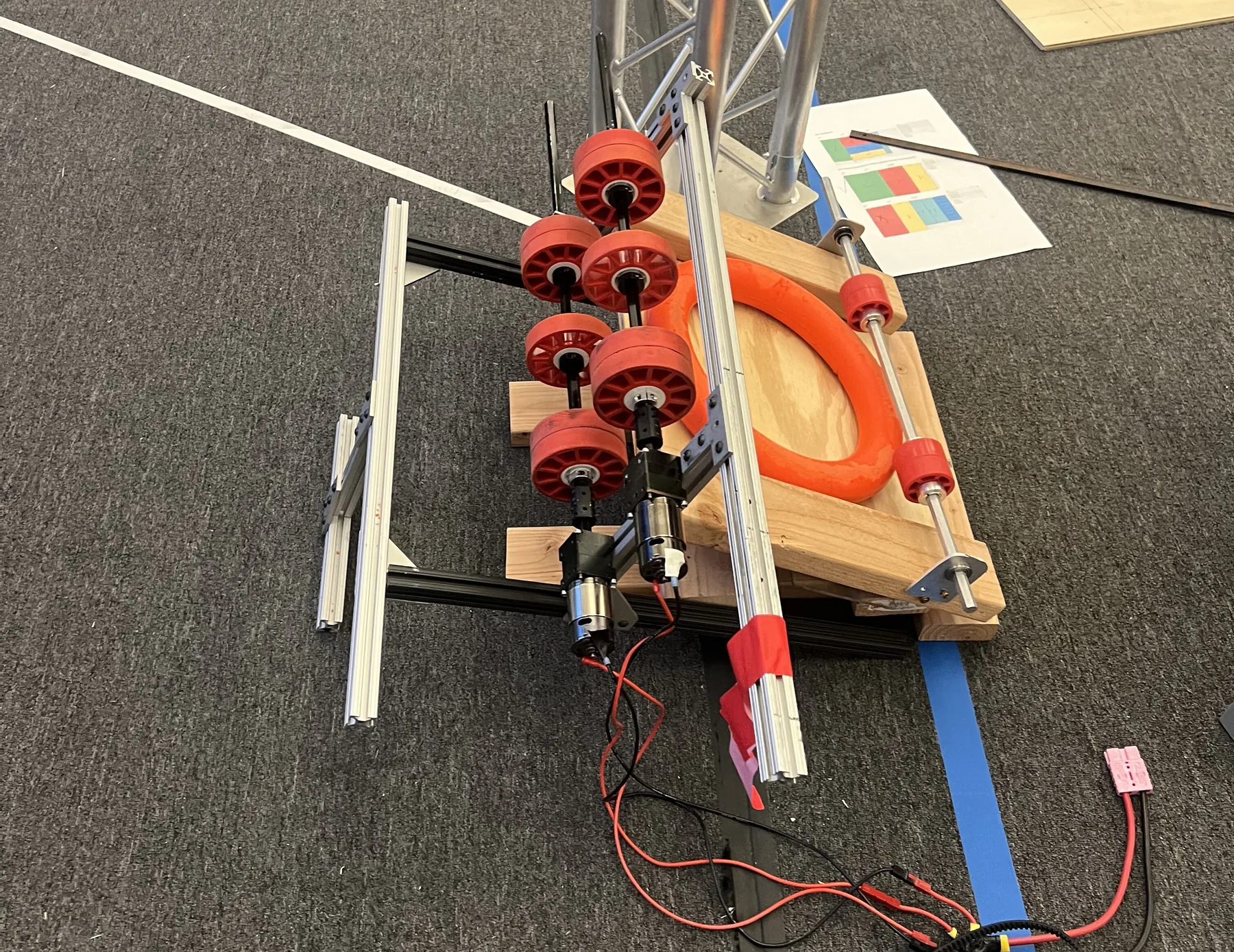
Seven design iterations (V1–V7). The intake picks notes up from the floor and folds back inside the frame when it hits something.
- Ground pickup: wall detection and sensor-based game-piece tracking.
- Virtual four-bar geometry: stores inside the frame perimeter and extends 12 inches to collect.
- Collision response: 1/4" polycarbonate arms with chain drive that give way on impact.
- Sensors: beam-break sensors detect the note for automated pickup.
- Belts: 10 polyurethane belts (5 per side) so the note is collected at any robot speed.
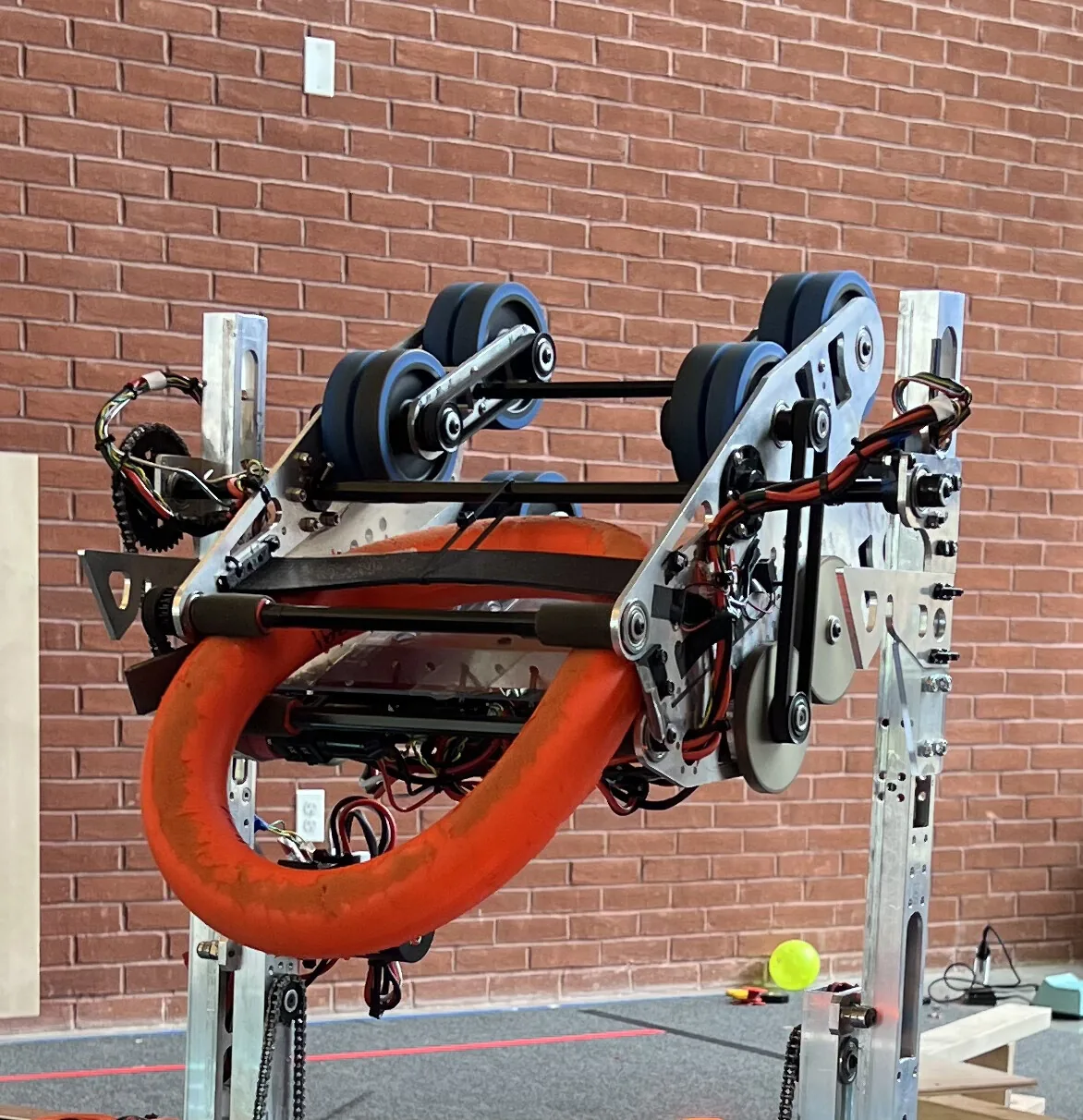
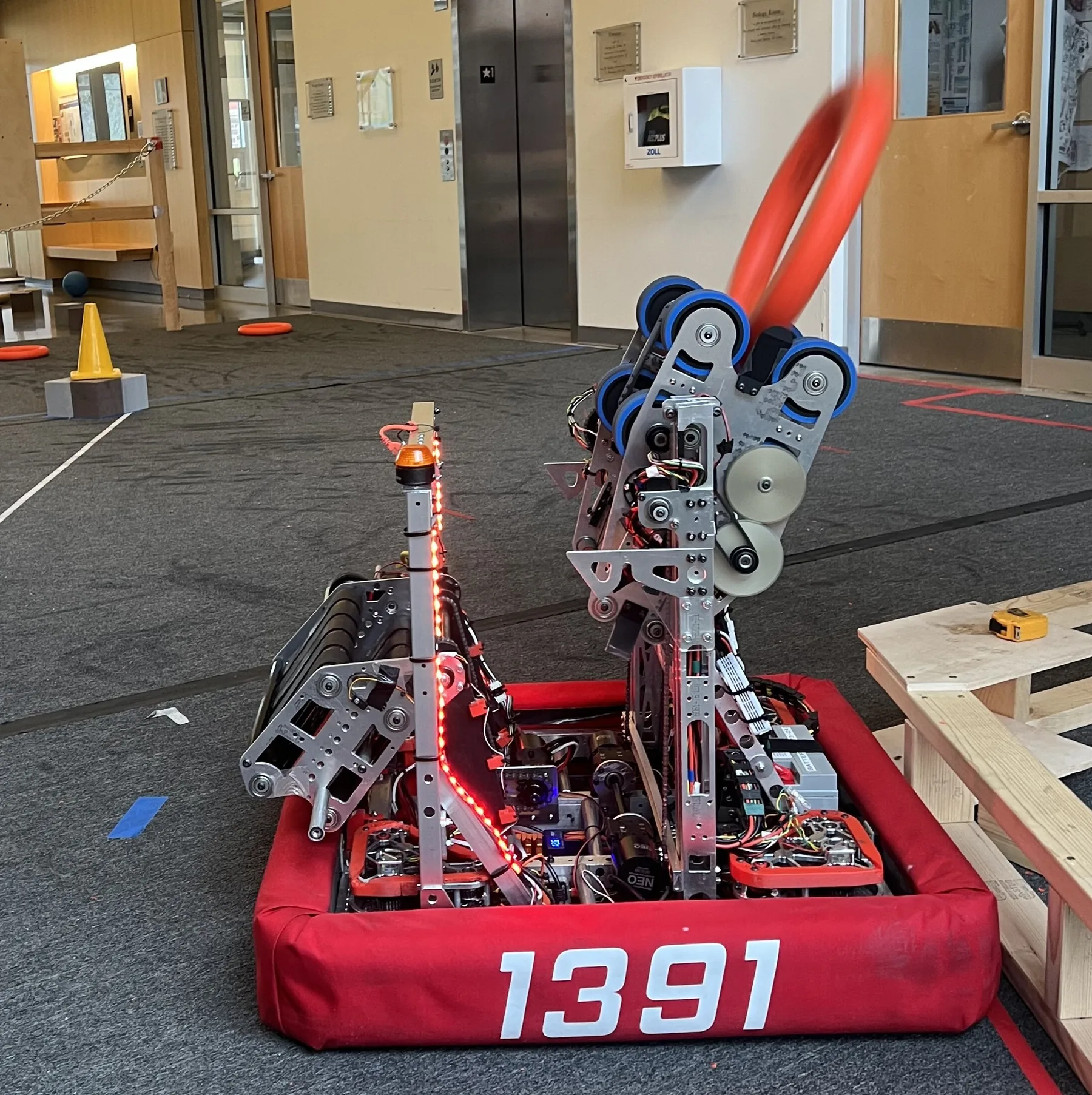
Adjustable shooter
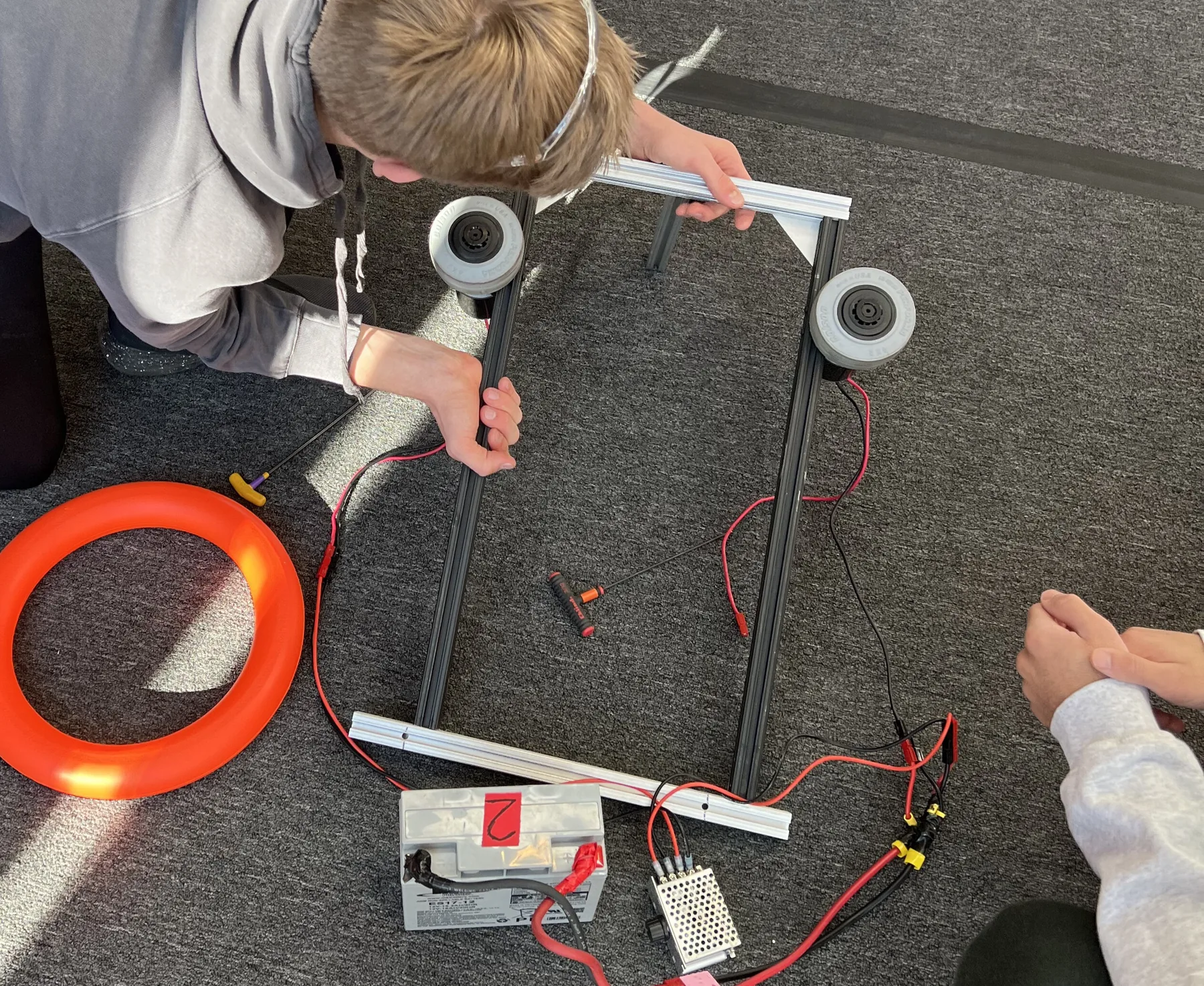
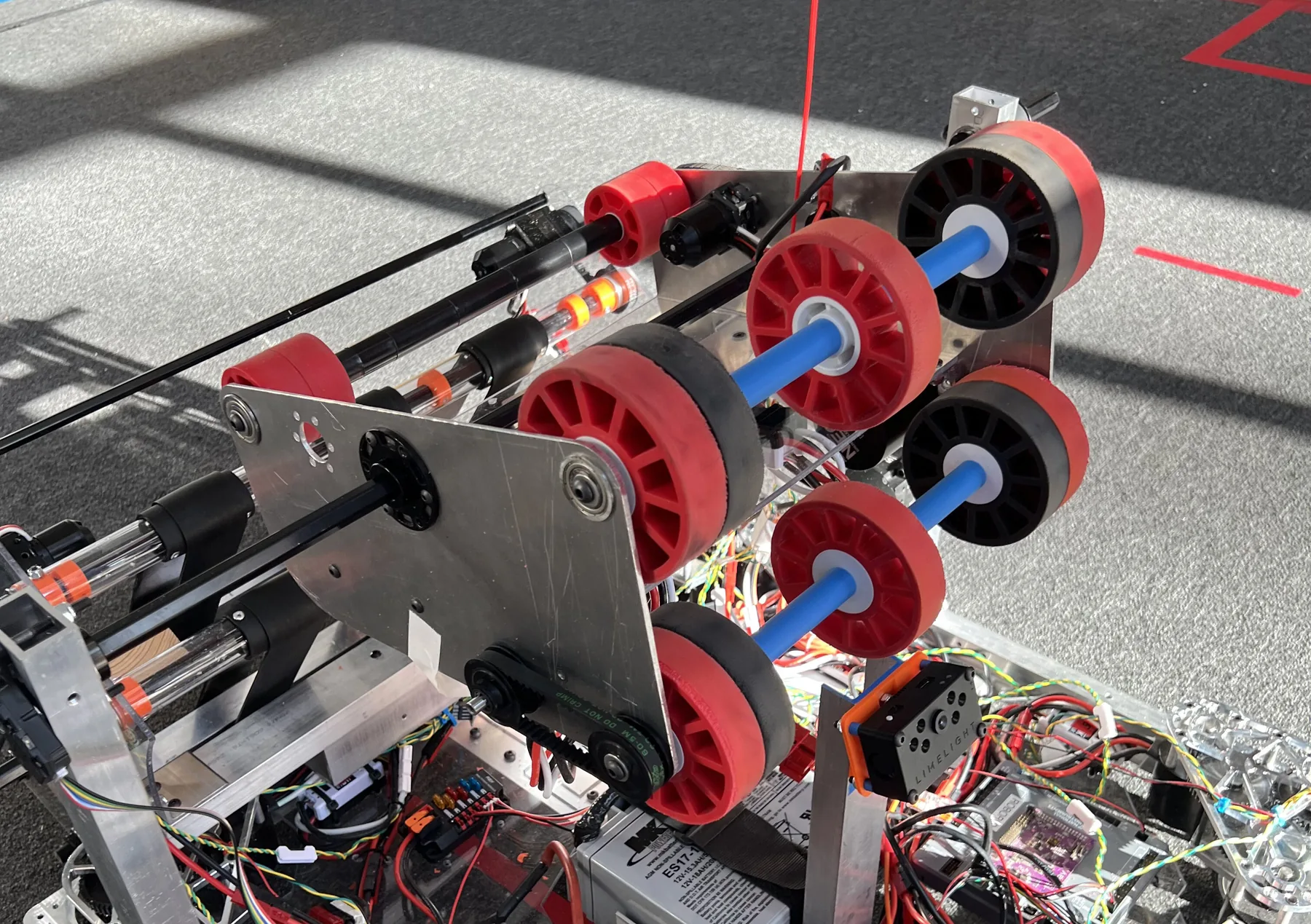
Several prototype rounds to get consistent long-range shots with automated targeting.
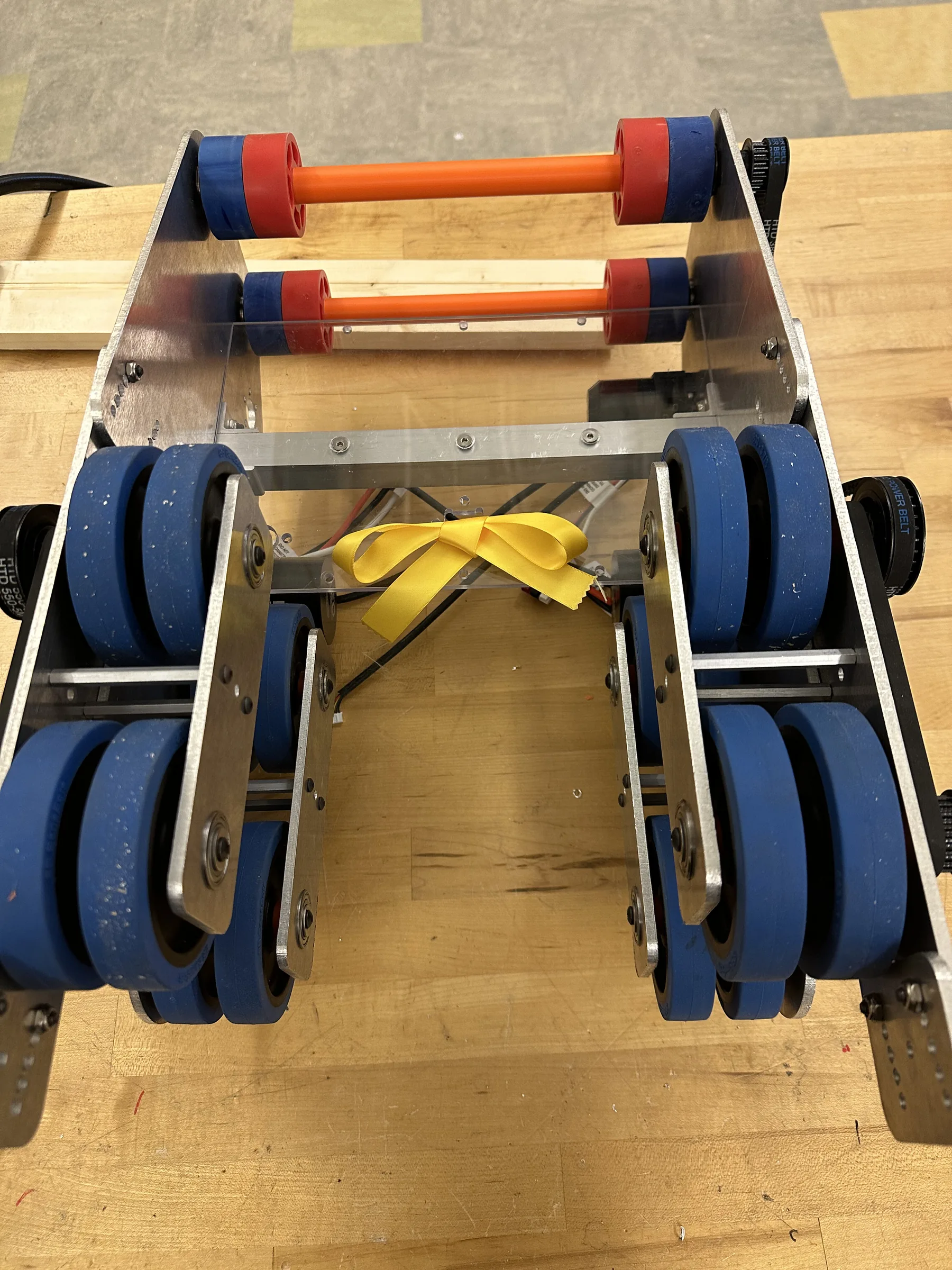
- Dual flywheels: two rows of wheels with independent speed control for spin.
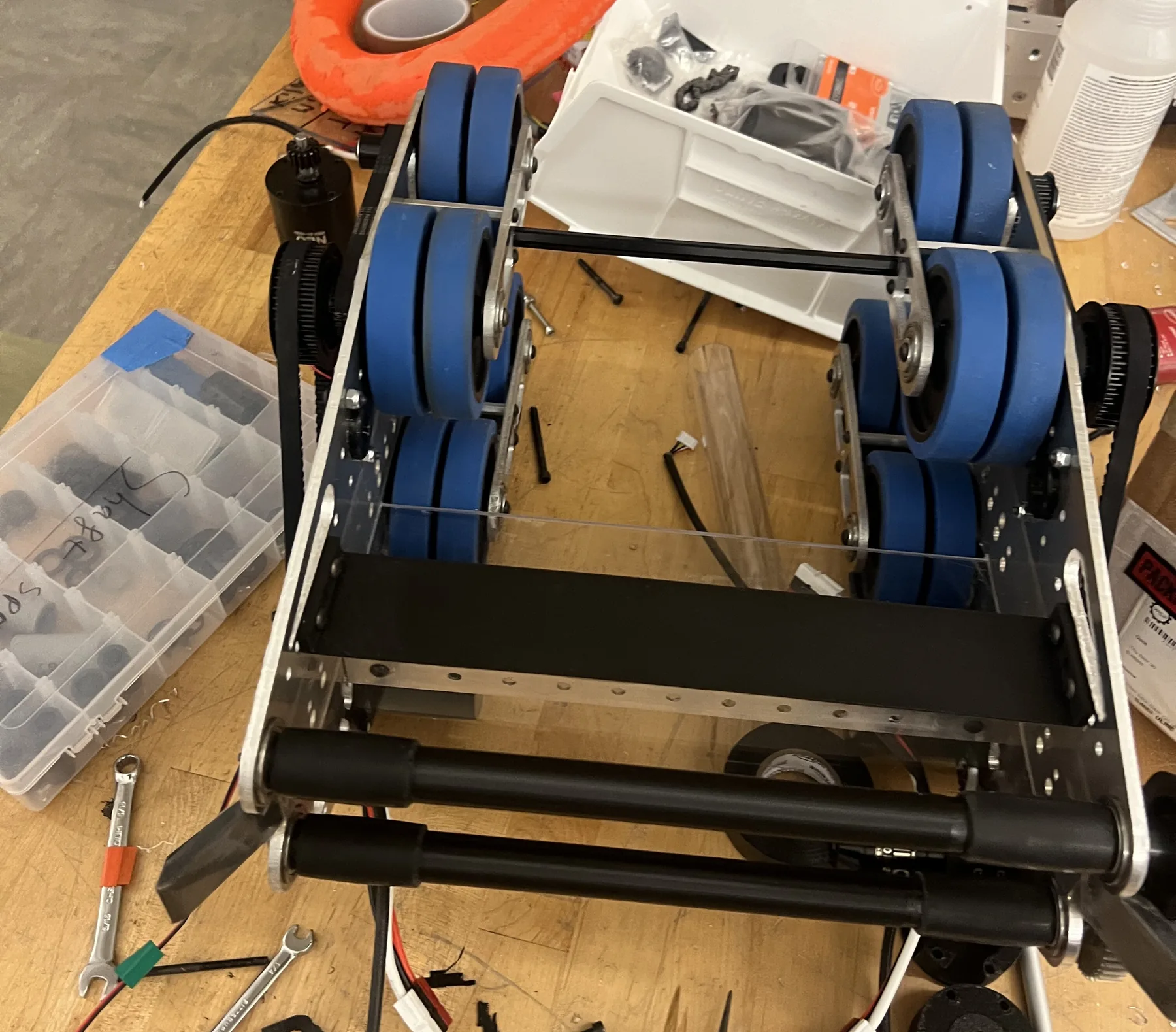
- Compression: 1.5" compression distance, found by testing.
- Centered pivot: keeps the center of gravity low.
- 3D-printed hood: geometry tuned for the note trajectory.
- Vision: Limelight targeting with distance calculation.
Elevator and climber
- Two stages: inner rails slide on outer rails on bearings.
- Shooter mount: through-bore encoder for rotation control.
- Stability: redesigned after the first competition with C-channel support and chain drive.
- Height: reaches the amp and trap scoring positions.
26" × 26" swerve drive base
- Footprint: small enough to fit all subsystems and nothing more.
- Center of gravity: belly pan as low as possible.
- Weight: 1/16" box tubing on the inner rails with material removed where it was not needed.
- Mounting: end caps for box connections without angle brackets.
Prototypes
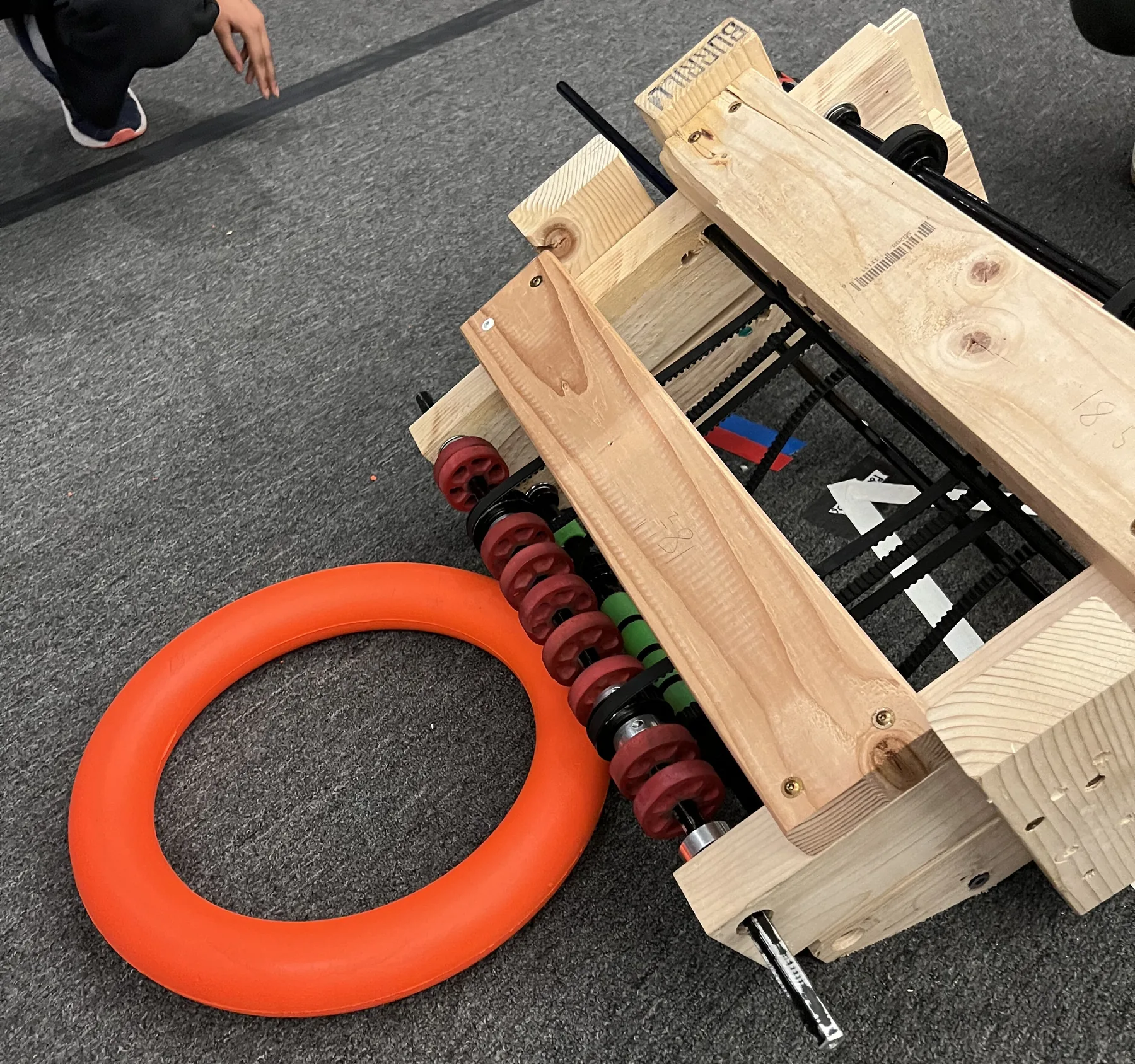
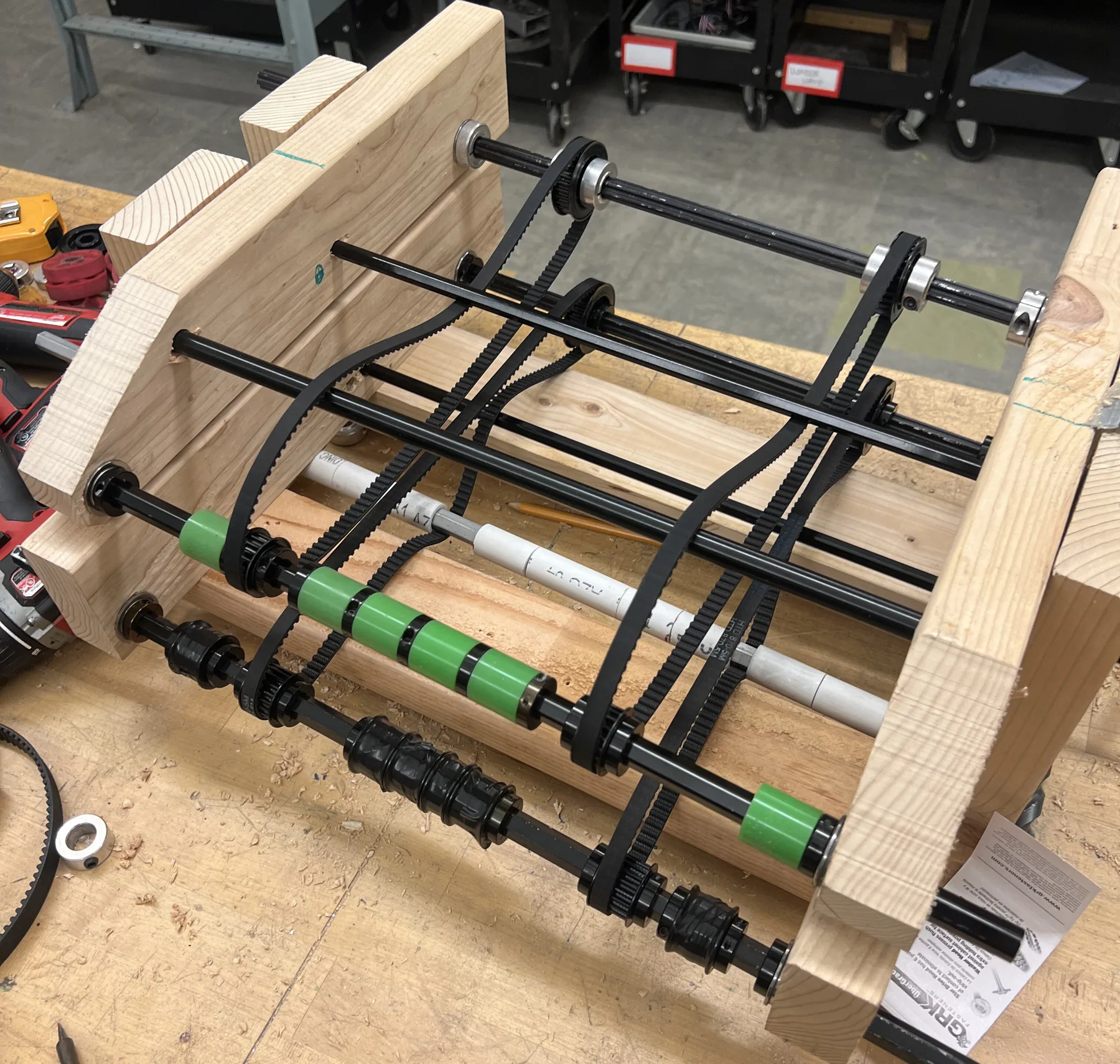
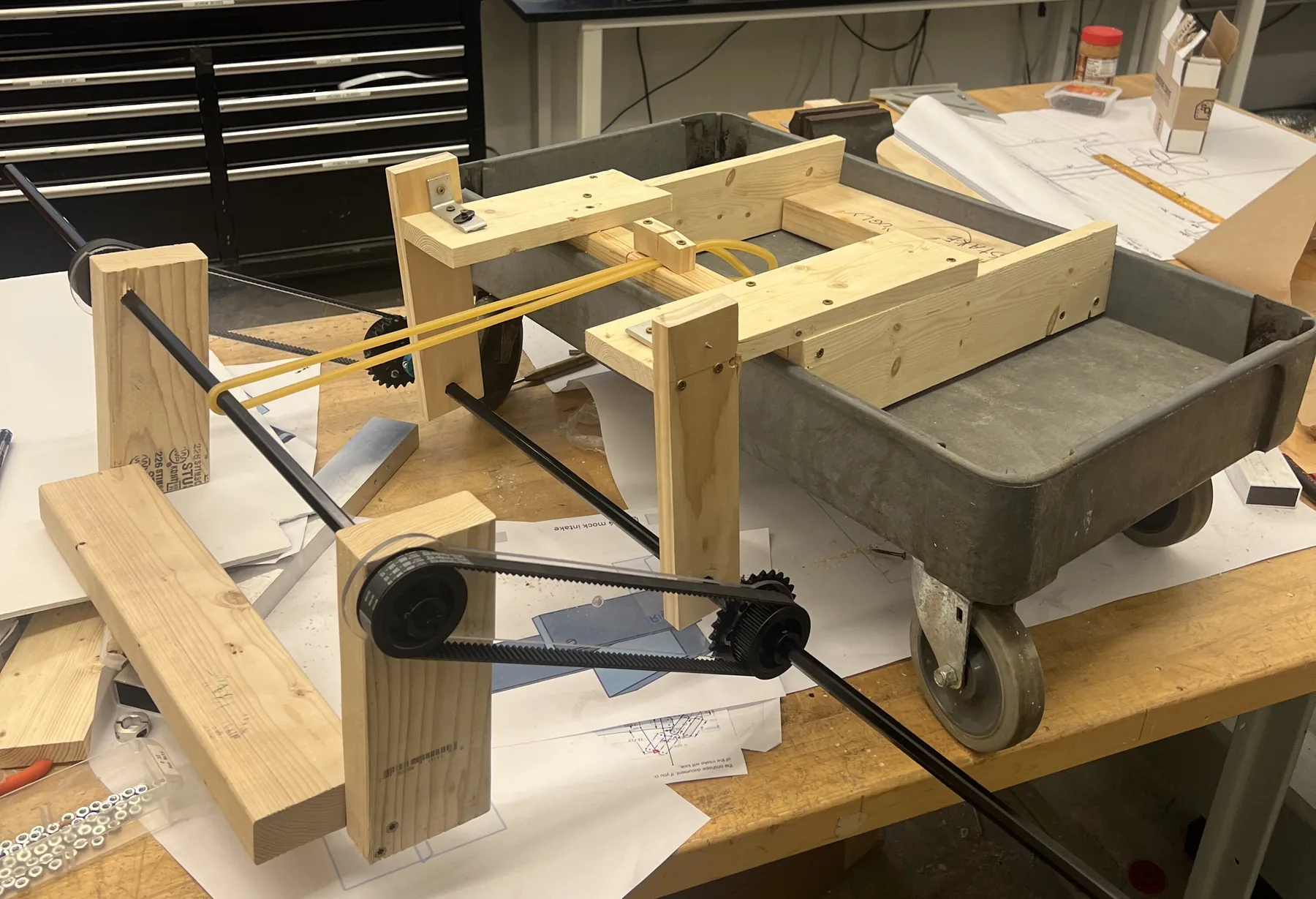
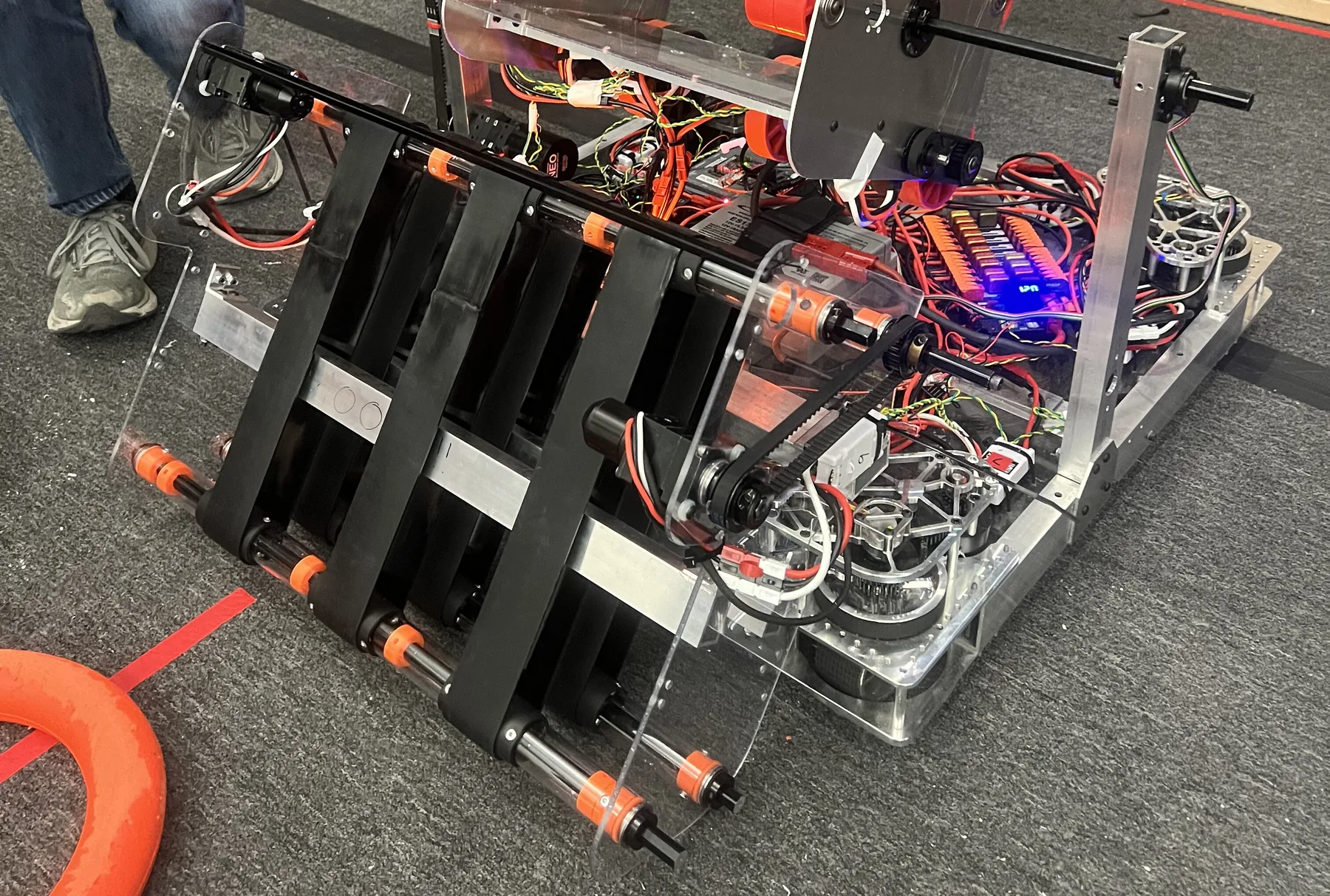
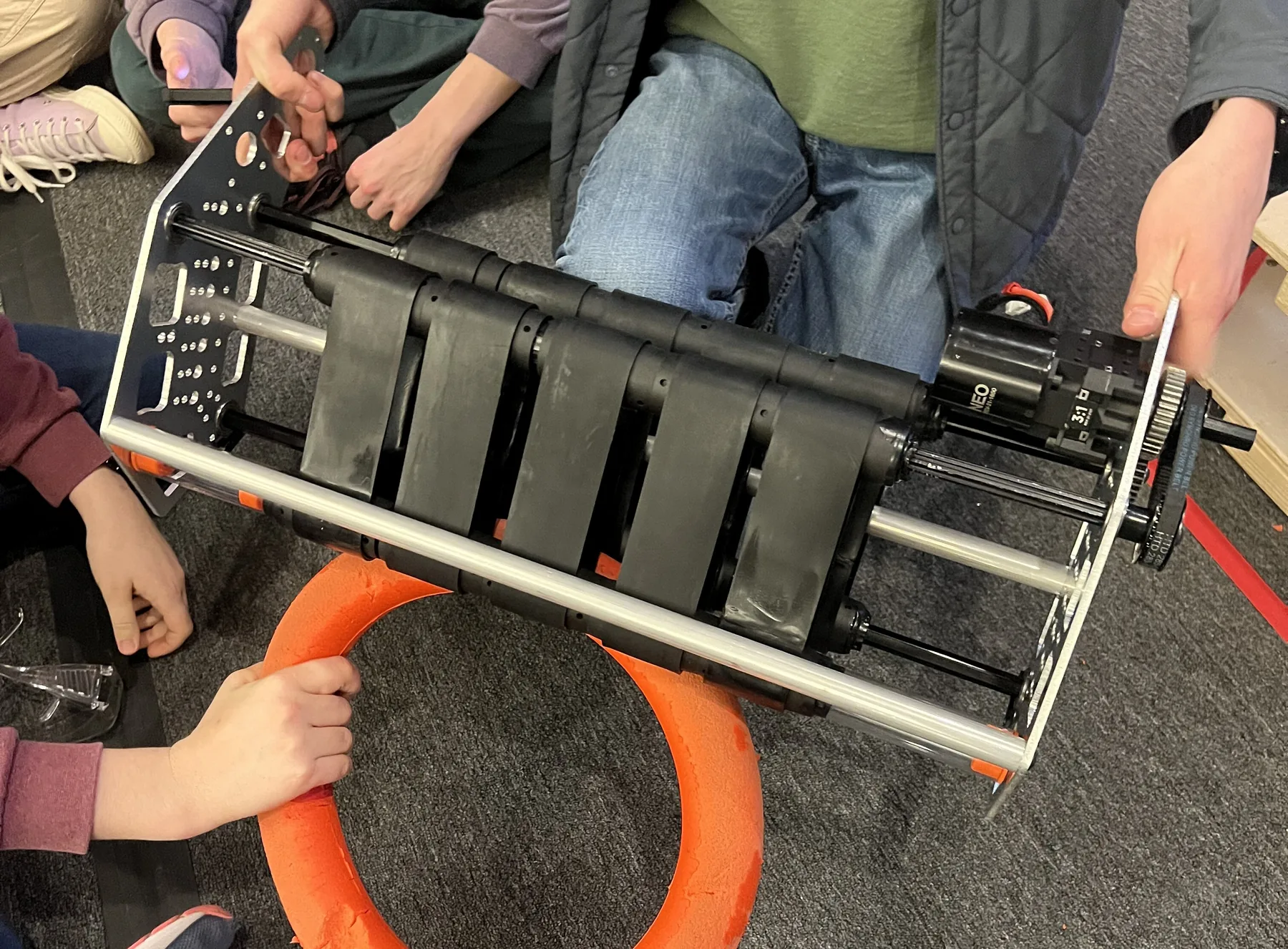
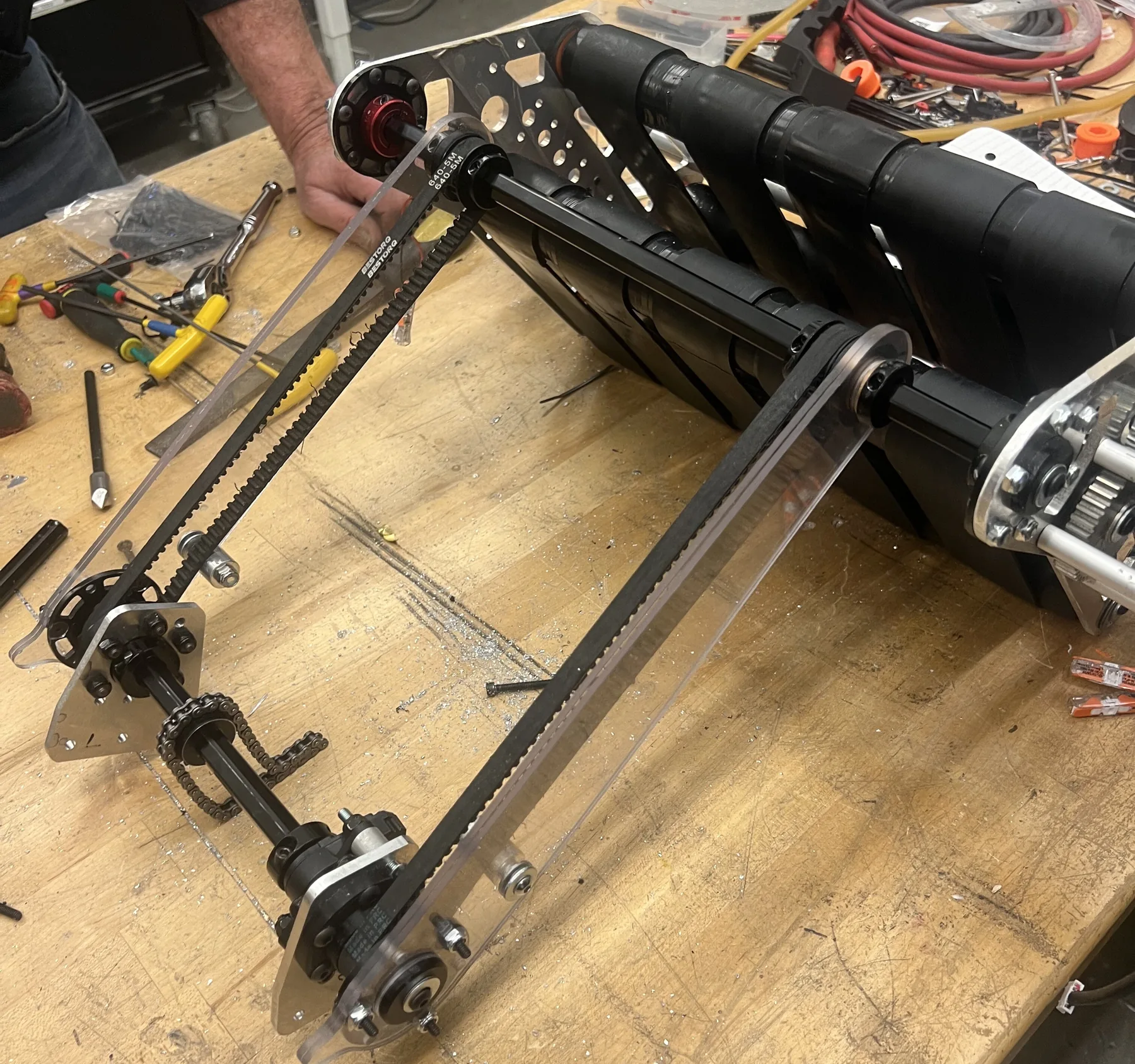
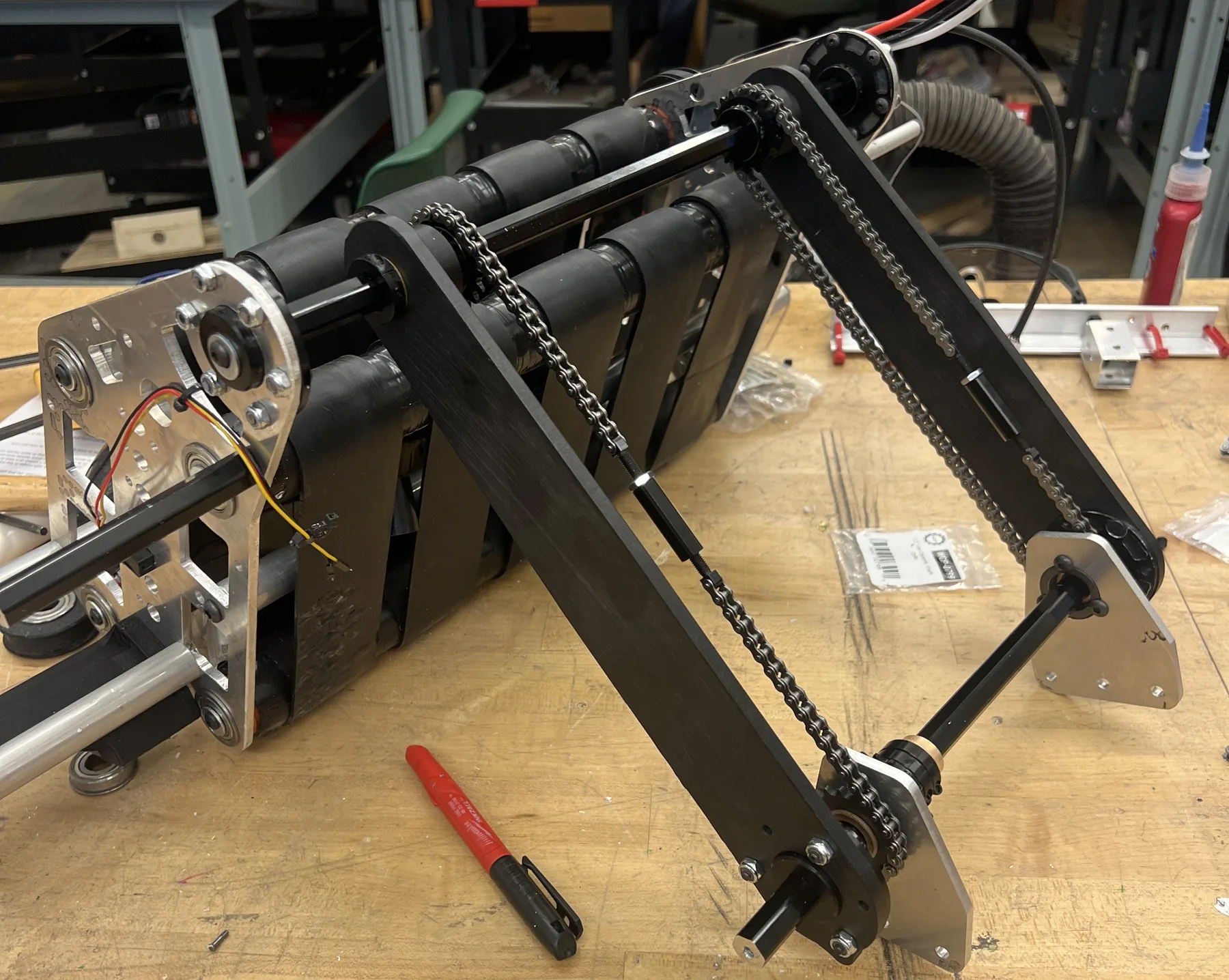
Both the intake and the shooter went through documented prototype iterations before the competition version.
Intake iterations (V1–V7)
Shooter iterations (V1–V5)
Robot in action
The 2024 robot collecting and scoring notes.
Competition results
- World Championship qualification, ranked in the top 3% globally.
- District Championship Finalist.
- Engineering Excellence Award, for the design and documentation.
- Quality Award, for design and manufacturing.
- Engineering Inspiration Award.
- Autonomous Award, twice.
Process
- Prototyping: wooden mock-ups to validate each concept.
- CAD: modeling and simulation in Fusion 360.
- Iteration: seven intake versions and six shooter versions, each documented.
- Sensors: beam-break sensors, encoders and vision.
- After each competition: changes based on match performance.
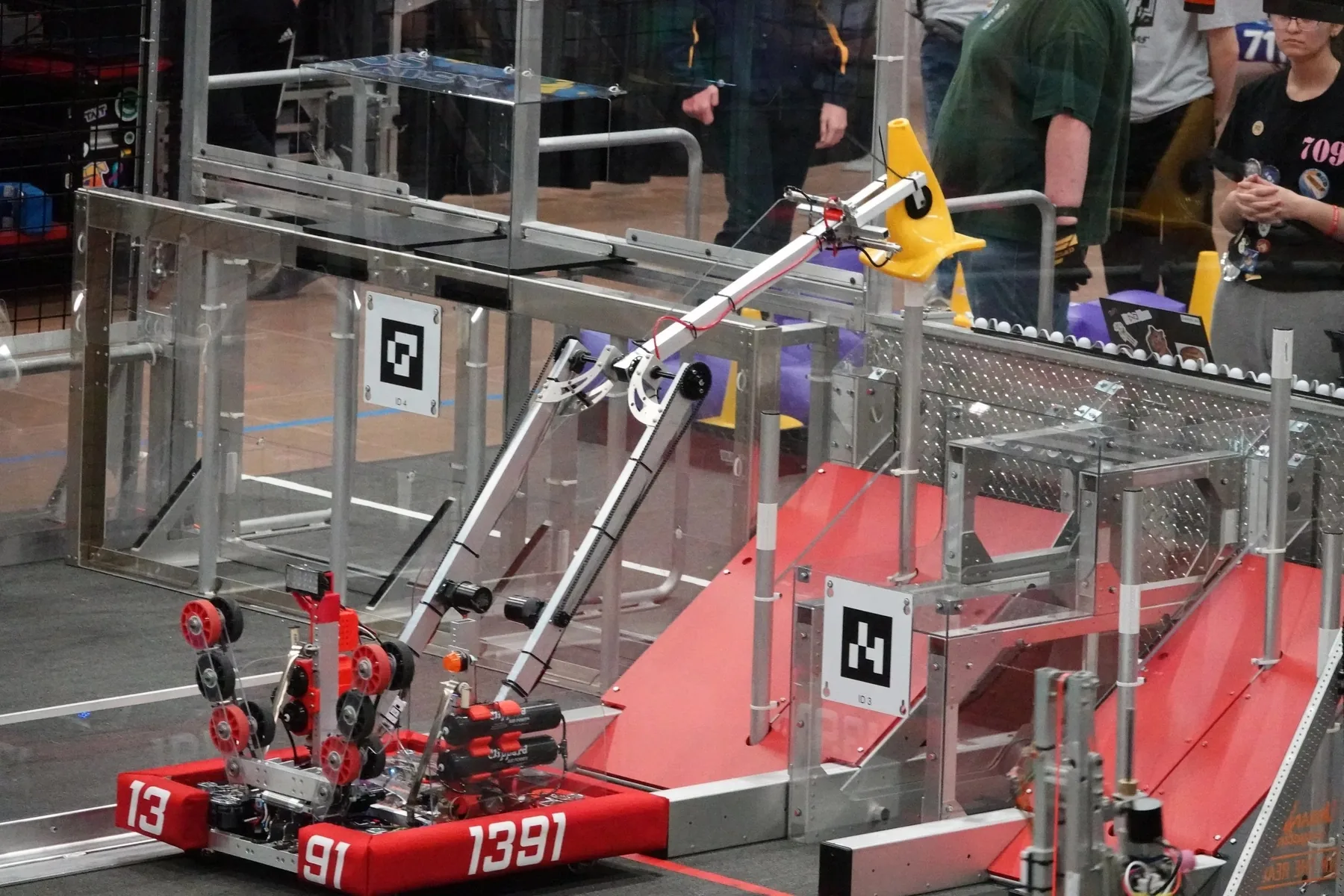
In 2023 (CHARGED UP) I was Team Captain, Lead Builder and Robot Operator. Our robot "BAMI" handled both cones and cubes at every scoring height. It had a swerve drive chassis, a two-joint arm, and a V4 grabber with Sorbothane grip pads. Autonomous scoring used AprilTag vision.
Mechanical systems
Swerve drive chassis
Omnidirectional drivetrain for positioning on the field.
- 27" × 27" frame: sized for charge-station balancing.
- Steel electronics board: custom-machined, placed low for center of gravity.
- Tip resistance: could tilt to 80 degrees without falling over.
- Countersunk holes: flat-head screws so nothing catches on the charge station.
- Cutouts: component access without removing the board.
- Motion: full 360° rotation and translation.
Two-joint arm (shoulder and elbow)
Double-jointed arm placing game pieces from ground level to the high grid.
- Two joints: shoulder and elbow rotation points for reach.
- Chain drive: shoulder motors mounted low in the frame for center of gravity.
- Through-bore encoders: angle feedback on both joints.
- Structure: 1×2 box tubing with material removed where it was not needed.
- Chain upgrade: #35 chain on the shoulder joint (from #25) after reliability problems.
- Reach: all three grid levels plus ground pickup.
V4 grabber
Four iterations to a gripper that handles both cones and cubes.
- Sheet metal: the V4 grabber is machined from sheet metal.
- Sorbothane grip pads: replaced the wheel-based grip of the early versions.
- Two pneumatic pistons: linear actuation with variable grip force.
- 3D-printed mounts: for component integration.
- Pressure-sensitive: grips each game-piece type with the right force.
- Smaller paddles: V4 paddles reduce cube over-gripping and sticking.
- Sensors: automated grip on detection.
Over-the-bumper intake
Seven iterations to a floor-collection system for both cones and cubes.
- 12.5-degree opening: wide capture range.
- Two wheel layers: enough grip without launching pieces.
- Virtual four-bar: stores inside the frame perimeter and extends to collect.
- 1/8" polycarbonate arms: thicker than the first version to reduce flex.
- Constant-force springs: assist deployment and retraction.
- Sensors: automatic piece handling.
- Cone orientation: gravity orients the bottom-heavy cones.
AprilTag vision
Vision for autonomous and driver-assisted alignment when scoring.
- AprilTag detection: fiducial markers identify the grid position.
- Distance: target area (
getTA()) of 3.4% for the scoring distance. - Centering: x-axis offset (
getTX()) for horizontal alignment. - Driver assist: automated positioning for consistent scoring.
- Autonomous: vision-based scoring during the autonomous period.
Competition results
- Bensalem District Event Champion.
- District Event Finalist at a second district event.
- Autonomous Award, sponsored by Ford, for the AprilTag-based autonomous.
- Excellence in Engineering Award, for the arm design and documentation.
- Quality Award, for design and manufacturing.
What we learned
- Materials: moved from wheels to Sorbothane pads after grip testing.
- Center of gravity: calculated to avoid tipping with the arm at full reach.
- Vision: AprilTag alignment improved scoring consistency.
- Prototyping: seven intake versions and four grabber versions; physical tests beat guessing.
- Balancing: the swerve chassis made charge-station balancing repeatable in autonomous.
In 2022 (Rapid React) I was a builder on our robot "Gustavo". It had an unlimited-rotation turret with a slip ring for continuous vision tracking, a three-stage climbing elevator that traversed to the high bar, and a thirty-wheel indexer with color sensors. The team qualified for the World Championship in Houston, Texas.
Mechanical systems
Unlimited-rotation turret with vision tracking
Shooting platform with continuous 360° rotation and vision-based targeting.
- Slip ring: the Limelight camera is powered through a slip ring, so the turret can rotate without limit.
- Auto-targeting: retroreflective tape detection with real-time angle calculation.
- NEO motor: built-in encoder for angle positioning.
- One-to-one gearing: the Limelight rotates with the turret.
- Four flywheels: speed varies with distance.
- Hood: a combination of CNC-cut and 3D-printed parts for the ball trajectory.
- Distance calculation: the RoboRIO adjusts power from the measured range.
Three-stage climber
Belt-and-piston elevator for the traversal bar, with anti-swing features.
- Belt and piston: bar-to-bar traversal to the high and traversal bars.
- Anti-swing: a piston pulls the robot closer to the bar to lower its center of mass during the climb.
- Two hook types: fixed and moving hooks with set tilt angles.
- Spring-loaded fixed hooks: let the bar slide through between stages.
- Aluminum channel: belts and bearings integrated in the channel.
- Manufacturing: parts made on the CNC router, mill, 3D printer and lathe.
- Four hooks: redundant attachment at each climbing stage.
Thirty-wheel indexer
Indexing system with color sensors for cargo sorting and tracking.
- 30 wheels: guide the cargo from intake to flywheels.
- Color sensors: track the cargo and identify alliance color.
- Rejection: the indexer reverses to eject wrong-colored cargo.
- Speed adjustment: flywheel speed varies with cargo type and condition.
- Position tracking: knows where each ball is inside the robot.
- Driver feedback: indicators show cargo status.
- Feed rate: timing between intake, indexing and shooting.
Over-the-bumper intake
Two pneumatic arms with vision-assisted ball recognition.
- Pneumatic polycarbonate arms: compliant but durable.
- Low pivot: the arms pivot away from impacts.
- Powered wheels: intake wheels on the arm fronts.
- Second Limelight: front-facing camera for ball recognition and tracking.
- Driver assist: auto-rotation to center on the nearest cargo.
- Five-ball autonomous: ran without precise starting alignment.
Tank drive with mixed wheels
- West Coast drive base.
- Wheels: four Versa wheels with two front omni wheels for turning.
- Turning: the omni wheels ease the turning radius without losing straight-line speed.
- Single-speed gearbox.
- Vision: works with the two Limelights for collection and shooting.
- Parts: CNC mill and router.
Competition results
- World Championship qualification, Houston, Texas.
- Creativity Award, sponsored by Rockwell Automation. Competition 1, rank 10 (11-6-0).
- Autonomous Award, sponsored by Ford. Competition 2, rank 5 (10-7-0).
- Competition 3: rank 12 (8-6-0).
- Several semifinal and quarterfinal appearances.
Firsts for the team
- Slip ring: the first continuous-rotation vision tracking system the team had built.
- Multi-stage climb: traversal mechanism with anti-swing control.
- Sensors: two Limelights plus color sensors.
- Automation: driver-assist through collection, indexing and shooting.
- Manufacturing: CNC routing, milling, 3D printing and lathe work.
- Five-ball autonomous.
Results
- World Championship qualification in 2022 (Houston, Texas) and 2024; the 2024 robot ranked in the top 3% globally.
- Bensalem District Event Champion and District Event Finalist in 2023; District Championship Finalist in 2024.
- Engineering Excellence awards in both 2023 and 2024, and the Quality Award in both years.
- Autonomous Award in 2022, 2023 and twice in 2024; Creativity Award in 2022; Engineering Inspiration Award in 2024.
- The engineering notebooks I wrote became the team's documentation standard.
Resources
Each season's design rationale, iterations and test data are in the team engineering notebook.
Engineering notebook 2024
CRESCENDO: four-bar intake, adjustable shooter, elevator and swerve base.
Engineering notebook 2024 (PDF)Engineering notebook 2023
CHARGED UP: BAMI's double-jointed arm, V4 grabber and AprilTag vision.
Engineering notebook 2023 (PDF)Engineering notebook 2022
Rapid React: Gustavo's slip-ring turret, three-stage climber and thirty-wheel indexer.
Engineering notebook 2022 (PDF)What I learned
The six-week build season forces quick decisions. There is no time to perfect every detail in CAD when you need a working prototype to test, so I learned to build mock-ups early and iterate on what happens on the floor rather than on what the model says.
Leading 30+ students across mechanical, electrical, programming and business sub-teams showed me that mechanisms alone do not win matches. When the intake team and the programmers were not talking, the hardware did not work either. Communication between subsystems, clear documentation and a shared understanding of constraints matter as much as clever design.
The Engineering Excellence awards told us that judges care about process as much as results. The notebooks stuck as a team standard because they made us write down not just what we built but why each decision was made and how we tested it.
Things break on the field. Sensors fail, mechanisms bend, alliance partners have bad matches. The teams that do well are the ones that can diagnose in the pits, repair under time pressure and change strategy to what is actually working. That habit has carried into every engineering project since.
Skills
- CAD: Fusion 360 and SolidWorks.
- Manufacturing: CNC mill, CNC router, lathe, 3D printing and sheet metal.
- Mechanical design: prototyping, weight reduction, center-of-gravity management.
- Controls: motor controllers, encoders, sensors and pneumatics.
- Vision: Limelight setup, AprilTag tracking, automated targeting.
- Integration: coordinating mechanical, electrical and programming work.
- Documentation: engineering notebooks with design rationale and iteration records.